
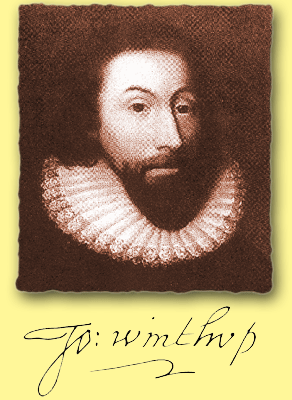
 The Puritan Dilemma: The Story of John Winthrop
(1958) (Edmund S. Morgan 1916-)
The Puritan Dilemma: The Story of John Winthrop
(1958) (Edmund S. Morgan 1916-)
[H]e which would have suer peace and joye in Christianitye, must not ayme at a condition retyred from the world and free from temptations, but to knowe that the life which is most exercised with tryalls and temptations is the sweetest, and will prove the safeste. For such tryalls as fall within compasse of our callinges, it is better to arme and withstande them than to avoide and shunne them. -John Winthrop
There, in Winthrop's own words, is the Puritan dilemma of which Mr. Morgan speaks here, "the paradox that required a man to live in the world without being of it." Or, as Mr. Morgan explains more fully:
Superficially Puritanism was only a belief that the Church of England should be purged of its hierarchy and of the traditions and ceremonies inherited from Rome. But those who had caught the fever knew that Puritanism demanded more of the individual than it did of the church. Once it took possession of a man, it was seldom shaken off and would shape--some people would say warp--his whole life. Puritanism was a power not to be denied. It did great things for England and America, but only by creating in the men and women it affected a tension which was at best painful and at worst unbearable. Puritanism required that a man devote his life to seeking salvation but told him he was helpless to do anything but evil. Puritanism required that he rest his whole hope in Christ but taught him that Christ would utterly reject him unless before he was born God had foreordained his salvation. Puritanism required that man refrain from sin but told him he would sin anyhow. Puritanism required that he reform the world in the image of God's holy kingdom but taught him that the evil of the world was incurable and inevitable. Puritanism required that he work to the best of his ability at whatever task was set before him and partake of the good things that God had filled the world with but told him he must enjoy his work and his pleasures only, as it were, absent-mindedly, with his attention fixed on God. In this short biography, Mr. Morgan traces how John Winthrop (1588-1669) struggled with the dilemma, first internally, as he dealt with the question of whether traveling to the New World represented a selfish form of "separatism", the desire to separate himself from an impure England, or whether, as he eventually determined, it offered a unique opportunity to set an example for all men by establishing a shining "Citty upon a Hill", a purer Christian community in the Massachusetts Bay Colony. In this regard, it seems to have been of vital importance to Winthrop and his fellow Puritan colonists that they had the imprimatur of the King and that though they were physically distancing themselves from the Church of England, they were not actually renouncing it.
Once settled in Massachusetts, where he became the first governor, John Winthrop faced a series of related challenges flowing from different facets of the Puritan dilemma. The first question concerned how the colony was to be governed, how "democratically" as we would say now. Here, the Puritan concept of the "covenant" with God, which bound them to His laws, led naturally into the idea that the people so bound should have a covenant among themselves about how to enforce God's laws.
The second, a classic form of separatism, arose most spectacularly in the person of Roger Williams, who thought it necessary for the members of a congregation to "make a public declaration of their repentance for having communion with the churches of England, while they lived there." Thus it was sufficient in his eyes to have banished that Church's errors from Puritan congregations; it was even necessary to renounce the Church. Winthrop understood the danger of Williams's ideas, that they might/must lead one to keep withdrawing further and further from the world and burrowing deeper into oneself, in the ultimately mistaken belief that only one's own vision of God's truth is pure.
Third, in the confrontation with Anne Hutchinson, Winthrop faced the sins of Arminianism, the belief that one could influence God and secure salvation by "preparing" oneself to receive it, and of Antinomianism, the belief that since God has predetermined who is to be saved one's behavior here on Earth does not matter, that one's sinfulness or "goodness" have no meaning. The former encourages one group to feel itself superior to others. The latter, as Mr. Morgan says, represents a form of nihilism. Both must be poisonous to any society.
Lastly, Winthrop faced the question of what position the City on the Hill should adopt towards necessarily more corrupt foreign states, from the mother country of England to Roger Williams's new colony in Rhode Island. It may be here that his practicality shows to best effect, and that the relatively democratic nature of the society the Puritans had established shows to its worst:
Winthrop saw what few men in any age have learned, that the foreign policy of even the holiest state must support one evil in order to suppress a worse one. Because it requires uncommon wisdom to recognize this fact, and still greater wisdom to choose rightly among the manifold evils of the world, foreign affairs have always suffered when exposed to the undiscriminating zeal of legislative assemblies. Winthrop had frequent cause to regret the increased power of the deputies, for the zeal of the deputies and sometimes even of the magistrates against all outlanders was a constant handicap to him in handling foreign affairs. Thus the tension between a splendid isolation and a more robust internationalism.
What Mr. Morgan manages in this book is to show us that even 370 years ago, Winthrop was already confronting many of what would be enduring themes and challenges of the American experiment. The struggle over how democratic America should be has been at the very core of our politics. Separationism would eventually lead to revolution and the split with Great Britain and then would explode most disastrously in the Civil War. Elitism (Arminianism) has been evident in America's troubled history of race relations and periodic bouts of xenophobic anti-immigrant fever. Twentieth Century nihilism (Antinomianism) would prove far more virulent than the Seventeenth Century variant, because no longer at least a function of religious faith. And, Isolationism has been a constant temptation, mostly working to our advantage but also leaving us unprepared for things like Pearl Harbor and 9-11.
As Mr. Morgan notes in his introduction, the Puritans are not terribly well regarded in modern America:
We have to caricature the Puritans in order to feel comfortable in their presence. They found answers to some human problems that we would rather forget. Their very existence is an affront, a challenge to our moral complacency; and the easiest way to meet the challenge is to distort it into absurdity, turn the challengers into fanatics. [...] But if one comes to Mr. Morgan's account of Winthrop's life with an open mind, it seems hard to imagine not being impressed by how nearly he and his fellows succeeded in what they set out to do:
The purpose of New England was to show the world a community where the laws of God were followed by church and state--as nearly as fallible human beings could follow them. To an almost discouraging degree, we must say that we still face many of the same challenges that Winthrop did, and that, for all our disdain of the Puritans, we aren't meeting the challenges as well as they did. Indeed, God's commission to America has no terminal date and, though it remains a shining City on a Hill to the rest of the world and though as fallible men we will never perfect the community, the effort to even try and come close to the kingdom has flagged. Winthrop's example, and Mr. Morgan's fine book, should serve as reminders that we've been closer and should dedicate ourselves to coming closer again.
GRADE: A+
Buy The Puritan Dilemma at Amazon.com. (Reviewed:) Grade: (A+) Tweet Websites:-WIKIPEDIA: Edmund S. Morgan -INDEX: Edmund S. Morgan (American Heritage) -ESSAY: Poor Richard's New Year: Is it peculiarly American to want to make yourself a better person? (Edmund S. Morgan, 12/31/02, NY Times) -PROFILE: The Historian's Historian (EDWARD NAWOTKA, 12/9/2002, Publishers Weekly) -REVIEW ESSAY: Secrets of Benjamin Franklin (Edmund S. Morgan, January 31, 1991, The New York Review of Books) -LECTURE: An Address to the Colonial Society of Massachusetts, on the Occasion of Its Centennial (Edmund S. Morgan, Sep 1993, The New England Quarterly) -ESSAY: The Puritan Ethic and the American Revolution (Edmund S. Morgan, Jan 1967, William and Mary Quarterly) -ESSAY: The Postponement of the Stamp Act (Edmund S. Morgan, July 1950, William and Mary Quarterly) -ESSAY: The Labor Problem at Jamestown, 1607-18 (Edmund S. Morgan, June 1971, The American Historical Review) -ESSAY: Slavery and Freedom: The American Paradox (Edmund S. Morgan, The Journal of American History) -ESSAY: The First American Boom: Virginia 1618 to 1630 (Edmund S. Morgan, April 1971, William and Mary Quarterly) -ESSAY: The American Revolution: Revisions in Need of Revising (Edmund S. Morgan, Jan 1957, William and Mary Quarterly) -REVIEW: of The Coming of the Revolution, 1763-1775 by Lawrence Henry Gipson (Edmund S. Morgan, The American Historical Review) -REVIEW: of Winthrop's Boston: Portrait of a Puritan Town, 1630-1649 by Darrett B. Rutman (Edmund S. Morgan, The American Historical Review) -REVIEW: of The Legend of the Founding Fathers by Wesley Frank Craven (Edmund S. Morgan, The Journal of Southern History) -REVIEW: of The Eighteenth-Century Commonwealthman by Caroline Robbins (Edmund S. Morgan, The Journal of Modern History) -REVIEW: of A Yankee's Odyssey: The Life of Joel Barlow by James Woodress (Edmund S. Morgan, The American Historical Review) -REVIEW: of Messrs. William Pepperrell: Merchants at Piscataqua by Byron Fairchild (Edmund S. Morgan, The American Historical Review) -REVIEW: of Seedtime of the Republic: The Origin of the American Tradition of Political Liberty by Clinton Rossiter (Edmund S. Morgan, The Journal of Southern History) -REVIEW ESSAY: Miller's Williams: a review of The Complete Writings of Roger Williams (Edmund S. Morgan, The New England Quarterly) -REVIEW ESSAY: John Adams and the Puritan Tradition: a review of Diary and Autobiography of John Adams (Edmund S. Morgan, Dec 1961, The New England Quarterly) -REVIEW: of The Stamp Act Congress: With an Exact Copy of the Complete Journal by C. A. Weslager (Edmund S. Morgan, The Journal of American History) -REVIEW: of Adams Family Correspondence edited by L. H. Butterfield, Marc Friedlaender (Edmund S. Morgan, The American Historical Review) -REVIEW: of The Social Structure of Revolutionary America by Jackson Turner Main (Edmund S. Morgan, The Journal of Southern History) -REVIEW: of Meeting Hill 1630-1783 by Ola Elizabeth Winslow (Edmund S. Morgan, William and Mary Quarterly) -REVIEW: of Thomas Pownall, British Defender of American Liberty; A Study of Anglo-American Relations in the Eighteenth Century by John A. Schutz (Edmund S. Morgan, The Mississippi Valley Historical Review) -REVIEW: of The Declaration of Independence and What it Means Today by Edward Dumbauld (Edmund S. Morgan, The American Historical Review) -REVIEW: of The New Nation: A History of the United States During the Confederation, 1781-1789 by Merrill Jensen; The Letters of Benjamin Franklin and Jane Mecom edited by Carl Van Doren; and Jane Mecom: The Favorite Sister of Benjamin Franklin by Carl Van Doren (Edmund S. Morgan, William E. Lingelbach, The American Historical Review) -REVIEW: of Benjamin Franklin's Letters to the Press, 1758-1775 by Verner W. Crane (Edmund S. Morgan, The American Historical Review) -REVIEW: of The Atlantic Civilization: Eighteenth-Century Origins by Michael Kraus (Edmund S. Morgan, The Mississippi Valley Historical Review) -REVIEW: of The Devil in Massachusetts: A Modern Inquiry into the Salem Witch Trials by Marion L. Starkey (Edmund S. Morgan, The American Historical Review) -INTERVIEW: Fifty Years of American History: An Interview with Edmund S. Morgan (David T. Courtwright, April 1987, William and Mary Quarterly) -Colonial America BookNotes: Edmund Sears Morgan (1916- ) -The Yale University Bookstore - Edmund S. Morgan -BOOK PAGE: Benjamin Franklin (Yale University Press) -PROFILE: Ben Franklin (HILLEL ITALIE, 7/29/02, Associated Press) -PROFILE: Searching for Ben (CBS News, 11/18/02) -AWARD: Edmund S. Morgan, The Rise of Popular Sovereignty in England and America (Bancroft Prize 1989) -ARTICLE: National Humanities Medal awarded to historian Morgan (Susan Gonzalez, January 12, 2001, Yale Bulletin and Calendar) -ESSAY: Colonial Jamestown: Our True Beginnings According to Edmund S. Morgan (Vicky Smith) -Colonial America BookNotes: Edmund Sears Morgan The Puritan Dilemma: The Story of John Winthrop -Study Questions for Edmund Morgan's Puritan Dilemma (Sally Hadden) -ESSAY: Preparation and Confession: Reconsidering Edmund S. Morgan's Visible Saints (in Reconsiderations) (Michael G. Ditmore, june 1994, The New England Quarterly) -ARCHIVES: The New York Review of Books: Edmund S. Morgan -ARCHIVES: "edmund s. morgan" (Find Articles) -REVIEW: of Benjamin Franklin by Edmund S. Morgan (Jonathan Yardley, Washington Post) -REVIEW: of Benjamin Franklin by Edmund S. Morgan (Susan Dunn, NY Times Book Review) -REVIEW: of Benjamin Franklin by Edmund S. Morgan (Gordon S. Wood, NY Review of Books) -REVIEW: of Benjamin Franklin by Edmund S. Morgan (Ted Widmer, NY Observer) -REVIEW: of Benjamin Franklin (Marc Arkin, New Criterion) -REVIEW: of Benjamin Franklin (Max Hall, Boston Globe) -REVIEW: of Benjamin Franklin (LEE CEARNAL, Houston Chronicle) -REVIEW: of Benjamin Franklin (David L. Beck, San Jose Mercury News) -REVIEW: of The Puritan Dilemma: The Story of John Winthrop (Emil Oberholzer, Jr., The Mississippi Valley Historical Review) -REVIEW: of The Puritan Dilemma: The Story of John Winthrop (Richard S. Dunn, William and Mary Quarterly) -REVIEW: of The Puritan Dilemma: The Story of John Winthrop (J. H. Hexter, The New England Quarterly) -REVIEW: of The Puritan Dilemma: The Story of John Winthrop (Everett H. Emerson, American Quarterly) -REVIEW: of Prologue to Revolution: Sources and Documents on the Stamp Act Crisis, 1764-1766 by Edmund S. Morgan (Malcolm Freiberg, The New England Quarterly) -REVIEW: of Prologue to Revolution: Sources and Documents on the Stamp Act Crisis, 1764-1766 (John A. Schutz, William and Mary Quarterly) -REVIEW: of The Stamp Act Crisis; Prologue to Revolution (John R. Alden, The Mississippi Valley Historical Review) -REVIEW: of The Stamp Act Crisis: Prologue to Revolution (Robert H. Woody, The Journal of Southern History) -REVIEW: of The Stamp Act Crisis: Prologue to Revolution (O. M. Dickerson, The American Historical Review) -REVIEW: of The Stamp Act Crisis: Prologue to Revolution (Charles R. Ritcheson, William and Mary Quarterly) -REVIEW: of The Stamp Act Crisis (S. E. Morison, The New England Quarterly) -REVIEW: of Virginians at Home: Family Life in the Eighteenth Century by Edmund S. Morgan (Elizabeth Bancroft Schlesinger, William and Mary Quarterly) -REVIEW: of Virginians at Home: Family Life in the Eighteenth Century (Louis B. Wright, The Journal of Southern History) -REVIEW: of The Birth of the Republic: 1763-89 by Edmund S. Morgan (Max Savelle, William and Mary Quarterly) -REVIEW: of The Birth of the Republic, 1763-89 (Robert E. Moody, The New England Quarterly) -REVIEW: of The Birth of The Republic, 1763-89 (John R. Alden, The American Historical Review) -REVIEW: of The Birth of the Republic, 1763-89 (Aubrey C. Land, The Mississippi Valley Historical Review) -REVIEW: of Roger Williams: The Church and the State by Edmund S. Morgan (Sidney V. James, William and Mary Quarterly) -REVIEW: of Roger Williams: The Church and the State (Emery Battis, The Journal of American History) -REVIEW: of Roger Williams: The Church and the State (Robert Ernst, American Quarterly) -REVIEW: of Roger Williams: The Church and the State (Samuel Hugh Brockunier, The American Historical Review) -REVIEW: of Roger Williams: The Church and the State (Darrett B. Rutman, The New England Quarterly) -REVIEW: of The Founding of Massachusetts: Historians and the Sources by Edmund S. Morgan (Aubrey C. Land, The Journal of Modern History) -REVIEW: of The Founding of Massachusetts: Historians and the Sources (Bruce T. McCully, The New England Quarterly) -REVIEW: of The Founding of Massachusetts: Historians and the Sources (Richard C. Simmons, William and Mary Quarterly) -REVIEW: of The Gentle Puritan: A Life of Ezra Stiles, 1727-1795 by Edmund S. Morgan (Whitfield J. Bell, Jr., William and Mary Quarterly) -REVIEW: of The Gentle Puritan: A Life of Ezra Stiles, 1727-1795 (Merle Curti, The Journal of Modern History) -REVIEW: of The Gentle Puritan: A Life of Ezra Stiles, 1727-1795 (James Edward Scanlon, History of Education Quarterly) -REVIEW: of American Slavery, American Freedom: The Ordeal of Colonial Virginia by Edmund S. Morgan (Oscar Handlin, The American Historical Review) -REVIEW: of American Slavery--American Freedom: The Ordeal of Colonial Virginia (Richard S. Dunn, William and Mary Quarterly) -REVIEW: of American Slavery, American Freedom: The Ordeal of Colonial Virginia (Russell R. Menard, The Journal of American History) -REVIEW: of American Slavery--American Freedom: The Ordeal of Colonial Virginia (Michael G. Kammen, The Journal of Southern History) -REVIEW: of American Slavery, American Freedom: The Ordeal of Colonial Virginia (J. R. Pole, The Historical Journal) -REVIEW: of American Slavery, American Freedom: The Ordeal of Colonial Virginia (Jack P. Greene, Political Science Quarterly) -REVIEW: of American Slavery - American Freedom: The Ordeal of Colonial Virginia (Rhys Isaac, Reviews in American History) -REVIEW: of American Slavery, American Freedom: The Ordeal of Colonial Virginia. By Edmund S. Morgan (Warren M. Billings, Virginia Historical Society) -REVIEW: of Visible Saints: The History of a Puritan Idea by Edmund S. Morgan (Louis L. Tucker, The American Historical Review) -REVIEW: of Visible Saints; The History of a Puritan Idea by Edmund S. Morgan (Norman Pettit, The New England Quarterly) -REVIEW: of Visible Saints: The History of a Puritan Idea (L. J. Trinterud, The Mississippi Valley Historical Review) The Colonial Scene (1602-1800): A Catalogue of Books Exhibited at the John Carter Brown Library -REVIEW: of The Challenge of the American Revolution by Edmund S. Morgan (David L. Ammerman, The New England Quarterly) -REVIEW: of The Meaning of Independence: John Adams, George Washington, Thomas Jefferson by Edmund S. Morgan (Carlton Jackson, The Journal of Southern History) -REVIEW: of The Meaning of Independence (Gregg L. Lint, The New England Quarterly) -REVIEW: of The Meaning of Independence: John Adams, George Washington, Thomas Jefferson (Jack P. Greene, The Journal of American History) -REVIEW: of The Meaning of Independence: John Adams, George Washington, Thomas Jefferson (Clarence L. Ver Steeg, The American Historical Review) -REVIEW: of Inventing the People: The Rise of Popular Sovereignty in England and America by Edmund S. Morgan (Edward Countryman, The Journal of Southern History) -REVIEW: of Inventing the People: The Rise of Popular Sovereignty in England and America (Donald S. Lutz, William and Mary Quarterly) -REVIEW: of Inventing the People: The Rise of Popular Sovereignty in England and America (Colin Brooks, The American Historical Review) -REVIEW: of Inventing the People: The Rise of Popular Sovereignty in England and America (Glenn W. LaFantasie, The New England Quarterly) -REVIEW: of Inventing the People: The Rise of Popular Sovereignty in England and America (Sydney V. James, Reviews in American History) -REVIEW: of Inventing the People: The Rise of Popular Sovereignty in England and America (Joyce Appleby, The Journal of American History) Book-related and General Links: -REVIEW ESSAY: Secrets of Benjamin Franklin (Edmund S. Morgan, January 31, 1991, The New York Review of Books) -LECTURE: An Address to the Colonial Society of Massachusetts, on the Occasion of Its Centennial (Edmund S. Morgan, Sep 1993, The New England Quarterly) -ESSAY: The Puritan Ethic and the American Revolution (Edmund S. Morgan, Jan 1967, William and Mary Quarterly) -ESSAY: The Postponement of the Stamp Act (Edmund S. Morgan, July 1950, William and Mary Quarterly) -ESSAY: The Labor Problem at Jamestown, 1607-18 (Edmund S. Morgan, June 1971, The American Historical Review) -ESSAY: Slavery and Freedom: The American Paradox (Edmund S. Morgan, The Journal of American History) -ESSAY: The First American Boom: Virginia 1618 to 1630 (Edmund S. Morgan, April 1971, William and Mary Quarterly) -ESSAY: The American Revolution: Revisions in Need of Revising (Edmund S. Morgan, Jan 1957, William and Mary Quarterly) -REVIEW: of The Coming of the Revolution, 1763-1775 by Lawrence Henry Gipson (Edmund S. Morgan, The American Historical Review) -REVIEW: of Winthrop's Boston: Portrait of a Puritan Town, 1630-1649 by Darrett B. Rutman (Edmund S. Morgan, The American Historical Review) -REVIEW: of The Legend of the Founding Fathers by Wesley Frank Craven (Edmund S. Morgan, The Journal of Southern History) -REVIEW: of The Eighteenth-Century Commonwealthman by Caroline Robbins (Edmund S. Morgan, The Journal of Modern History) -REVIEW: of A Yankee's Odyssey: The Life of Joel Barlow by James Woodress (Edmund S. Morgan, The American Historical Review) -REVIEW: of Messrs. William Pepperrell: Merchants at Piscataqua by Byron Fairchild (Edmund S. Morgan, The American Historical Review) -REVIEW: of Seedtime of the Republic: The Origin of the American Tradition of Political Liberty by Clinton Rossiter (Edmund S. Morgan, The Journal of Southern History) -REVIEW ESSAY: Miller's Williams: a review of The Complete Writings of Roger Williams (Edmund S. Morgan, The New England Quarterly) -REVIEW ESSAY: John Adams and the Puritan Tradition: a review of Diary and Autobiography of John Adams (Edmund S. Morgan, Dec 1961, The New England Quarterly) -REVIEW: of The Stamp Act Congress: With an Exact Copy of the Complete Journal by C. A. Weslager (Edmund S. Morgan, The Journal of American History) -REVIEW: of Adams Family Correspondence edited by L. H. Butterfield, Marc Friedlaender (Edmund S. Morgan, The American Historical Review) -REVIEW: of The Social Structure of Revolutionary America by Jackson Turner Main (Edmund S. Morgan, The Journal of Southern History) -REVIEW: of Meeting Hill 1630-1783 by Ola Elizabeth Winslow (Edmund S. Morgan, William and Mary Quarterly) -REVIEW: of Thomas Pownall, British Defender of American Liberty; A Study of Anglo-American Relations in the Eighteenth Century by John A. Schutz (Edmund S. Morgan, The Mississippi Valley Historical Review) -REVIEW: of The Declaration of Independence and What it Means Today by Edward Dumbauld (Edmund S. Morgan, The American Historical Review) -REVIEW: of The New Nation: A History of the United States During the Confederation, 1781-1789 by Merrill Jensen; The Letters of Benjamin Franklin and Jane Mecom edited by Carl Van Doren; and Jane Mecom: The Favorite Sister of Benjamin Franklin by Carl Van Doren (Edmund S. Morgan, William E. Lingelbach, The American Historical Review) -REVIEW: of Benjamin Franklin's Letters to the Press, 1758-1775 by Verner W. Crane (Edmund S. Morgan, The American Historical Review) -REVIEW: of The Atlantic Civilization: Eighteenth-Century Origins by Michael Kraus (Edmund S. Morgan, The Mississippi Valley Historical Review) -REVIEW: of The Devil in Massachusetts: A Modern Inquiry into the Salem Witch Trials by Marion L. Starkey (Edmund S. Morgan, The American Historical Review) -INTERVIEW: Fifty Years of American History: An Interview with Edmund S. Morgan (David T. Courtwright, April 1987, William and Mary Quarterly) -Colonial America BookNotes: Edmund Sears Morgan (1916- ) -The Yale University Bookstore - Edmund S. Morgan -BOOK PAGE: Benjamin Franklin (Yale University Press) -PROFILE: Ben Franklin (HILLEL ITALIE, 7/29/02, Associated Press) -PROFILE: Searching for Ben (CBS News, 11/18/02) -AWARD: Edmund S. Morgan, The Rise of Popular Sovereignty in England and America (Bancroft Prize 1989) -ARTICLE: National Humanities Medal awarded to historian Morgan (Susan Gonzalez, January 12, 2001, Yale Bulletin and Calendar) -ESSAY: Colonial Jamestown: Our True Beginnings According to Edmund S. Morgan (Vicky Smith) -Colonial America BookNotes: Edmund Sears Morgan The Puritan Dilemma: The Story of John Winthrop -Study Questions for Edmund Morgan's Puritan Dilemma (Sally Hadden) -ESSAY: Preparation and Confession: Reconsidering Edmund S. Morgan's Visible Saints (in Reconsiderations) (Michael G. Ditmore, june 1994, The New England Quarterly) -ARCHIVES: The New York Review of Books: Edmund S. Morgan -ARCHIVES: "edmund s. morgan" (Find Articles) -REVIEW: of Benjamin Franklin by Edmund S. Morgan (Jonathan Yardley, Washington Post) -REVIEW: of Benjamin Franklin by Edmund S. Morgan (Susan Dunn, NY Times Book Review) -REVIEW: of Benjamin Franklin by Edmund S. Morgan (Gordon S. Wood, NY Review of Books) -REVIEW: of Benjamin Franklin by Edmund S. Morgan (Ted Widmer, NY Observer) -REVIEW: of Benjamin Franklin (Marc Arkin, New Criterion) -REVIEW: of Benjamin Franklin (David L. Beck, San Jose Mercury News) -REVIEW: of The Puritan Dilemma: The Story of John Winthrop (Emil Oberholzer, Jr., The Mississippi Valley Historical Review) -REVIEW: of The Puritan Dilemma: The Story of John Winthrop (Richard S. Dunn, William and Mary Quarterly) -REVIEW: of The Puritan Dilemma: The Story of John Winthrop (J. H. Hexter, The New England Quarterly) -REVIEW: of The Puritan Dilemma: The Story of John Winthrop (Everett H. Emerson, American Quarterly) -REVIEW: of Prologue to Revolution: Sources and Documents on the Stamp Act Crisis, 1764-1766 by Edmund S. Morgan (Malcolm Freiberg, The New England Quarterly) -REVIEW: of Prologue to Revolution: Sources and Documents on the Stamp Act Crisis, 1764-1766 (John A. Schutz, William and Mary Quarterly) -REVIEW: of The Stamp Act Crisis; Prologue to Revolution (John R. Alden, The Mississippi Valley Historical Review) -REVIEW: of The Stamp Act Crisis: Prologue to Revolution (Robert H. Woody, The Journal of Southern History) -REVIEW: of The Stamp Act Crisis: Prologue to Revolution (O. M. Dickerson, The American Historical Review) -REVIEW: of The Stamp Act Crisis: Prologue to Revolution (Charles R. Ritcheson, William and Mary Quarterly) -REVIEW: of The Stamp Act Crisis (S. E. Morison, The New England Quarterly) -REVIEW: of Virginians at Home: Family Life in the Eighteenth Century by Edmund S. Morgan (Elizabeth Bancroft Schlesinger, William and Mary Quarterly) -REVIEW: of Virginians at Home: Family Life in the Eighteenth Century (Louis B. Wright, The Journal of Southern History) -REVIEW: of The Birth of the Republic: 1763-89 by Edmund S. Morgan (Max Savelle, William and Mary Quarterly) -REVIEW: of The Birth of the Republic, 1763-89 (Robert E. Moody, The New England Quarterly) -REVIEW: of The Birth of The Republic, 1763-89 (John R. Alden, The American Historical Review) -REVIEW: of The Birth of the Republic, 1763-89 (Aubrey C. Land, The Mississippi Valley Historical Review) -REVIEW: of Roger Williams: The Church and the State by Edmund S. Morgan (Sidney V. James, William and Mary Quarterly) -REVIEW: of Roger Williams: The Church and the State (Emery Battis, The Journal of American History) -REVIEW: of Roger Williams: The Church and the State (Robert Ernst, American Quarterly) -REVIEW: of Roger Williams: The Church and the State (Samuel Hugh Brockunier, The American Historical Review) -REVIEW: of Roger Williams: The Church and the State (Darrett B. Rutman, The New England Quarterly) -REVIEW: of The Founding of Massachusetts: Historians and the Sources by Edmund S. Morgan (Aubrey C. Land, The Journal of Modern History) -REVIEW: of The Founding of Massachusetts: Historians and the Sources (Bruce T. McCully, The New England Quarterly) -REVIEW: of The Founding of Massachusetts: Historians and the Sources (Richard C. Simmons, William and Mary Quarterly) -REVIEW: of The Gentle Puritan: A Life of Ezra Stiles, 1727-1795 by Edmund S. Morgan (Whitfield J. Bell, Jr., William and Mary Quarterly) -REVIEW: of The Gentle Puritan: A Life of Ezra Stiles, 1727-1795 (Merle Curti, The Journal of Modern History) -REVIEW: of The Gentle Puritan: A Life of Ezra Stiles, 1727-1795 (James Edward Scanlon, History of Education Quarterly) -REVIEW: of American Slavery, American Freedom: The Ordeal of Colonial Virginia by Edmund S. Morgan (Oscar Handlin, The American Historical Review) -REVIEW: of American Slavery--American Freedom: The Ordeal of Colonial Virginia (Richard S. Dunn, William and Mary Quarterly) -REVIEW: of American Slavery, American Freedom: The Ordeal of Colonial Virginia (Russell R. Menard, The Journal of American History) -REVIEW: of American Slavery--American Freedom: The Ordeal of Colonial Virginia (Michael G. Kammen, The Journal of Southern History) -REVIEW: of American Slavery, American Freedom: The Ordeal of Colonial Virginia (J. R. Pole, The Historical Journal) -REVIEW: of American Slavery, American Freedom: The Ordeal of Colonial Virginia (Jack P. Greene, Political Science Quarterly) -REVIEW: of American Slavery--American Freedom: The Ordeal of Colonial Virginia (Rhys Isaac, Reviews in American History) -REVIEW: of American Slavery, American Freedom: The Ordeal of Colonial Virginia. By Edmund S. Morgan (Warren M. Billings, Virginia Historical Society) -REVIEW: of Visible Saints: The History of a Puritan Idea by Edmund S. Morgan (Louis L. Tucker, The American Historical Review) -REVIEW: of Visible Saints; The History of a Puritan Idea by Edmund S. Morgan (Norman Pettit, The New England Quarterly) -REVIEW: of Visible Saints: The History of a Puritan Idea (L. J. Trinterud, The Mississippi Valley Historical Review) The Colonial Scene (1602-1800): A Catalogue of Books Exhibited at the John Ca |
Copyright 1998-2015 Orrin Judd
